Showing posts with label OCM. Show all posts

Tuesday, June 26, 2012

Jesus and Organizational Change Part I: Get Off Your Throne & Serve!

Posted by Todd VanNest on Tue, Jun 19, 2012

In last week’s post “Don’t be Nice..”, I commented on how to truly serve others in Leading Change by doing more than being supportive and a good listener (reactive).  You have to create the cognitive tension and self-assessment that engages both hearts and minds—allowing others to critically evaluate status quo as part of committing to the future (new mindsets and new practices).  By citing Servant Leadership, I prompted the following question in my mind:  What would Jesus do?

You’ve seen books on “Jesus as CEO” and the WWJD acronym stitched or etched into everything from wristbands to stone outcroppings in national parks.  My question here is not about preachin’ a Christian way or meant as blasphemy (by making the teachings of Christ mundane and of-this-world).  I do think that there are some practical lessons in thinking about how Jesus led change (whether to you He is your savior, an interesting person of history, or the product of a great novel).  I am certain that by selectively highlighting the things I’m speaking of in this 2-part post I am doing His leadership a great injustice, but I do regard even these small things as great gifts.

Today, in Part 1, I am highlighting the role of service in change leadership.

  • “You know that the rulers in this world lord it over their people, and officials flaunt their authority over those under them. But among you it will be different. Whoever wants to be a leader among you must be your servant, and whoever wants to be first among you must be the slave of everyone else. For even the Son of Man came not to be served but to serve others and to give his life as a ransom for many.” – (Mark 10:42-45)

Wow!...Leading change, and being appointed as a leader for guiding an organization through complex change is heady work…just don’t let it go to your head!

Out of this perspective, I offer two reflections for Change Leaders:

  • What tools and processes prescribed in modern approaches to organizational change have become the “trappings of the office” that might potentially distract me from fully, genuinely, and in-the-moment engaging the stakeholders of this change process? And
  • I’m sure that almost every Change Leader has, at some point, felt like a slave.  The question is, are you a slave to others or are you a slave to the process, politics, and promotion that defines “change management?”

At times, we feel like a slave to others—typically because our own approach to driving change is actually fueling or sustaining the resistance that we blame for making us a slave.  In reality, we have often sold-out others, forsaking them and authentic engagement with them in favor of serving a “program” or getting to some almighty “result.” When working with Change Teams to help them recover a stalled or failing change initiative, I often find that they start to recover the change effort when they realize that a bit more engagement early in the process would have actually saved them time and accelerated the realization of results—relative to where they find themselves at the moment (behind schedule and struggling to produce the promised results, having forsaken timely and genuine engagement).

  • WWJD?...Now THAT’s a heady challenge!  Look for more powerful reflections in Part 2 of this post in the coming days.

One way to serve others through change is to help them find meaning in change and make it more simple.

Last Word on Change

More on leading change simply: http://www.lastwordonchange.com/simple-solution

Thursday, October 7, 2010

Raising the Bar for Our Profession

October 5th, 2010 by Luc Galoppin

For an organizational change practitioner, lacking safety shoes is symptomatic for not being in touch with the reality of things. There is no chance for your expertise to get used as long as you stay inside the boardroom. Getting your expertise used – and the change to last – means raising the bar in two steps: relationship management and social architecture.

The profession of organizational change management is changing. And it is going in the right direction: clients no longer accept that 70% of the changes fails. And neither should you.

The arena of organizational change practitioners is packed with experts, tools and degrees. We could even add certification and other rituals, all to no avail. Being an expert is not sufficient anymore.

To make a difference, we need to raise the bar for our profession, by adding relationship management and social architecture to the requirements list. (click on the drawing to enlarge)


Level One: Your Expertise
Let’s face it: the days of boardroom consulting are over. Reality is no longer restricted to the 150 slides of your PowerPoint-Conference-Room-Pilot-Presentation. Slowly but surely clients are starting to understand that the proof of the pudding is in the eating, and that we should put our beautiful models to the test on the shop floor.

The moral of the safety boots is that you need to ‘go local’ in order to make a connection. If you really want to practice organizational change management you need to step out of your project cocoon, right into the field. You need to sit on the handrail with the people who will eventually execute your bright ideas.

Also, you need to sit through the long (and often very technical) discussions of problem solving. Be there when they share war stories and tinker with a solution until it fits. That’s really tough, because 99% of the time you are the dummy in the group. To most consultants that is total agony. Certainly, when your raison d’ĂȘtre is based upon being the expert in the room.

You are no longer the expert once you are on the shop floor.

Get over it.

Level Two: The Relationship
No matter how up-to-date your knowledge is; no matter how state-of-the-art your model is; you should always remember that implementation is the last 99%.

And implementation is a relationship thing. Thus, the first thing you need to be aware of is that you start as a foreign element, so pushing your expertise down the throats of people will not amount to great things.

But then how do you build a relationship? You listen. You zoom in on ‘What are they committed to?’ Then, you commit to their commitments. It’s the only way to win their hearts.

Major Jim Gant knows about relationships. His work on TTE – Tactical Tribal Engagement is unprecedented for counterinsurgency tactics in Iraq and Afghanistan. His contention is to work with tribalism, not against it. In his free ebook ‘One Tribe at a Time’ he talks about an “acceptable level of integration.”:

There is nothing (and I emphasize nothing) that can prove yourself and your team to the tribe more than fighting alongside them. That is the ultimate testament of your team as warriors and your commitment to the tribe. It will create the foundation for influence without authority that is the key to success in tribal engagement.

My ultimate test of relationship management is based on Major Jim Gant’s insights: do you have influence without authority? If yes, then you are ready to raise the bar to the next level.

Level Three: Social Architecture
Ask yourself: What will people be creating when you are gone?

This third level is about building a platform in order to sustain the change. It will require you to get out of the way and to allow a community or a club of people to take over.

Building such a community is not easy because it is not done with the pressure of authority. Rather, it is done through the gradual and consistent work of going local, being there, and connecting (the previous level: relationship management).

Typical examples of a platform include:

a community of key users of different plants who connect with one another based on their domain of expertise;
a community of learning architects who make sure that the best practices from different countries get spread all over the organization;
a community of training administrators who cater for the continuous training and authorization updates that are necessary after the implementation of an ERP project;
a support community that prides itself on a new support process and continuously improves it.
The only thing you need is an element that helps people to connect and share their knowledge: after a while, they declare this as their platform.

Raising the Bar
We are always told to start with the end in mind. As it turns out, the end we have in mind when we are stuck on the first level results in a 70% failure rate. Raising the bar to the level of relationship management and social architecture will urge us to think about different ends.

This, in turn, will shift our vision and influence our execution radically. But make no mistake: these three levels build upon one another.

You need expertise in order to get the job done. This gets your foot inside the door;
Next, you need to consistently prove that you are worthy of people’s trust;
Finally, when people allow you a landing slot on their airport of trust, you are ready to build a platform.
In the end, what does this mean for you as an organizational change practitioner? Consider the following entry criteria in order to enter the next level:

Be an expert, that is the bottom line;
Then, let go of the attachment to being an expert and do the emotional labor that builds trust;
Finally, in order to build a platform, you will need to get out of the way and allow the community to take over.
________
I would like to thank Daryl Conner for challenging me to refine this concept.

http://www.reply-mc.com/2010/10/05/raising-the-bar-for-our-profession/

Wednesday, March 24, 2010

Change Leadership vs. Change Management: Or to Put it Another Way, the Honeymoon’s Over

Currently, we are working with a client that is experiencing a common but unexpected challenge as they implement a new ERP software solution. The ERP implementation is organized with a senior team functioning as a steering committee. Reporting to them are the project manager, our consultants, a core team and ultimately the ERP users.

The ERP implementation was preceded by a ERP selection project that focused on the business requirements and the business case for the ERP implementation. Most of the members of the implementation team were a part of the ERP selection process in one capacity or another.

Now that the ERP implementation is underway and “the heavy lifting has begun,” we are experiencing some resistance within the ranks that needs to be addressed. The interesting element of this resistance is the source – the core project team.

The expectation is that the core project team would be the most intimate and committed members of the whole ERP implementation effort. Most of them were closely involved in the ERP software selection process. However, now their initial enthusiasm for the project has evolved into several forms of resistance.

Sources of ERP Resistance

  • The reality of their required commitment for completing the project
  • The amount of their resources that need to be deployed on the project
  • The difficult functionality decisions that have to be made, with the accompanying compromises
  • Their own competing personal agendas

Panorama’s ERP implementation and organizational change management projects focus on a list of critical success factors that help achieve change management and reduce resistance.

Critical Success Factors (CSFs) for Change Management

  • Truth
  • Accountability
  • Leadership
  • Engagement
  • Alignment

These CSF’s also apply to change leadership. The subtle but significant difference is that in change management we focus on what must be done to make the users of the ERP software successful with the new tools. Change leadership focuses on supporting all of the participants in the change management process. The project manager and project lead need to deal with this and still deliver an on-time and on-budget ERP implementation. The steering committee wants to provide support and wonders what to do.

Here is what we have suggested:

  • Lead by example. In addition to communicating the priority of the ERP implementation, show it. A decision was made to suspend one of the quarterly tasks that required a lot of time from the core team. The reason communicated was that right now the ERP project is the priority and the steering committee recognizes the core team’s resource challenges.
  • Support the champions. Vocal, public acknowledgment of the work being done on the project by the core team is tangible reinforcement of the priorities.
  • Challenge the undecided. Calling out the core team members constructively in the meetings (not public) will reinforce their accountability to the steering committee and each other.
  • Promote accountability. Be crystal clear with every member of the core team regarding choices and consequences. If there is responsible dissent about a deliverable or deadline, get it out on the table for debate in the meetings. Work the discussion to hammer out the best answer. Once a decision has been made, make sure everyone understands the shared commitment to it. The debate is over. Now, clearly explain the expectations.

Get everyone possible on board the train – it’s leaving the station with or without everyone on board. Following the prior point, the consequences of not delivering should be clear. Managing dissent constructively is a great way to create a much higher performing team. This approach might be new, and it might be uncomfortable, but it is this client’s reality and should be seen as an opportunity.

Ignoring resistance and doing nothing is also a choice. But it is a disastrous one.


http://panorama-consulting.com/change-leadership-vs-change-management-or-to-put-it-another-way-the-honeymoons-over/

Sunday, March 21, 2010

My 10 Ingredients for Change Management

by Yann Gourvennec on 14 March, 2010 - 21:17
note: this post is the unabridged version of a piece which was written for Bnet.co.uk of which I am a regular contributor

One of the interesting things happening after the Likeminds conference on 25 February in Exeter, was the Likeminds Summit which actually took place on the following day at Bovey Castle in Dartmoor. Obviously, there were a bunch of like-minded people around the table dealing with the issues of how to implement social media properly for businesses.

One of the recurring issues surrounding the implementation of social media was change management; a topic often touched on but rarely explained properly. For the benefit of our readers, I have put together a list of the 10 ingredients which I think are of the utmost importance when you want to set up change in your company. This list is based on my experience of implementing change at various companies throughout the world in the past 20 years:

The serenity prayer: the first ingredient is to always know what you can change and what you cannot change, and to ensure that you always will be able to tell the difference,
Think big, start small: obviously if you are trying to implement change it is because you have great ideas; but try and be reasonable and start small and then move on to bigger changes one step at a time,
Choose the path of least resistance: avoid these people resisting change at all cost and try not to waste time convincing them. On the contrary, focus on these other people who are more favourable to your project and work with them all the way up (they are what one calls change agents),
Ask your boss to set an example: when you want to change things, management has to show the way and to prove others that things can be done not only by ordering them around but by actually doing things by themselves,
Don’t think top down: on the contrary, don’t believe that just because top management is going to send an e-mail to all, things are going to start changing by themselves. They simply won’t,
Seek a mandate once (some) results have been proven. Or, if you already have a mandate, don’t show it until we have implemented a few results either. This will show people that you care about their opinion,
Respect people: the human factor is one of the most important in change management. Don’t underestimate people and try and convince them humanly,
Expect the best, but prepare for the worst: as always in project management, Murphy’s Law applies. Be prepared for the worst so that you can avoid it,
Act swiftly: change is best implemented in my eyes in a 3 to 6 month period. If nothing has happened before then, chances are that nothing ever will,
In times of trouble, don’t stop and speed up the change process on the contrary: times of chaos can be perceived as periods of danger by most people; yet, to most change managers they will be used as periods at which anything is possible. It’s mostly when things are uncertain that change is implemented and accepted, not the contrary.
Lastly, adhering to these 10 simple rules might not guarantee success but overlooking them will certainly mean failure.

Friday, March 5, 2010

Rethinking How to Get Employees to Change

Persuading employees to make lasting changes in their behavior isn't easy. Keith McFarland highlights lessons from a new book that might make you more effective at it

By Keith McFarland

Their 2008 Made to Stick was one of the most fun books on marketing in years—and became an instant classic. In their new book, Switch, the brothers Heath take on the subject of organizational change, and they make the often dry, sentimental, and buzz-word-laden subject suddenly relevant for anyone trying to get a bunch of people to change directions.

The book opens with a story from the Food & Brand Lab at Cornell University. Researchers set up at a movie theater and gave movie goers a free soft drink and bucket of popcorn—in exchange for them answering some questions about the concession stand at the end of the movie. Some of the moviegoers got a medium-size bucket of popcorn, and others got a huge tub. But here's the kicker—both groups were given five-day-old popcorn that was so stale it squeaked. The questions at the concession stand were just a ruse—food researchers were studying how portion size influences eating.

And does it ever. People given the big tub ate 53% more of the practically inedible stuff than people given the medium bucket.

A SITUATION, NOT A PEOPLE, PROBLEM

If you didn't know about the different containers, you'd probably scan the data and quickly assume that the participants could be easily divided into categories: Those with self control and those without it. You might jump to the conclusion that this was a people problem—and you might try to change the behavior of the people by punishing overeating or educating people on the perils of a high calorie diet. But you'd be wrong. What might look to be a people problem turns out to be a situation problem. The experiment was repeated often enough, controlling for all the known variables for researchers to explain the difference statistically with a very simple formula: When it comes to popcorn consumption, bigger bucket equals more eating.

If you are like me, by the time you get to page 2 in this book, you'll already be thinking about all your past efforts to create change in your own business. How many of those efforts stalled not because people are hopelessly resistant to change (they are not), but because we unknowingly created situations that encourage people to behave in ways contrary to the very direction of change we are trying to foster.

In my research on companies, I've found that leaders frequently jump to the conclusion they have a people problem when they really have a situation problem. Companies spend too much time worrying about getting the right people and not enough time worrying about getting the people right, (creating situations in a company where the natural response for employees is to perform at a high level).

MOTIVATING THE ELEPHANT

Switch is full of other gems, too. The book is organized around an incredibly useful analogy from University of Virginia psychologist Jonathan Haidt (he wrote The Happiness Hypothesis). When trying to get a human to change (anything from losing weight to embracing a new IT system), think of him as made up of two parts: The elephant and the rider. The elephant is his emotional side, and the rider is his rational side. Like the rider of an elephant, a person's rational side has theoretical control of the emotional side, but it is a precarious control. Far too often, the elephant runs off with the rider (we order that chocolate cake, dash off that scathing e-mail, or can never seem to find time to get our department behind that new corporate initiative).

According to Switch, there are three basic ways to help ensure that the change you are trying to make in your company actually sticks. You can (a) direct the rider (largely by reducing ambiguity about specifically what kind of change is needed); (b) motivate the elephant (often by finding things that trigger people's visceral response to a need for change; and (c) shape the path—so the elephant and rider can proceed more easily and directly to the goal.

Early in the book is the delightful story of Jon Stegner—who was tasked with reducing costs at a major manufacturing company. He believed the company's decentralized procurement system was wasting millions, but he knew that the divisions' elephants (emotions) would run for the jungle if they thought their autonomy or independence were being threatened. He needed to find a way to motivate the elephant. Then the college intern Stegner had hired made a discovery—each division in each factory ordered its own work gloves. The company was purchasing 424 different types of gloves, ranging in price from $3.22 to $17 per pair. Stegner's intern retrieved a pair of each type, added a price tag, piled all 424 pairs on a conference table in the boardroom, and invited all the division presidents to visit the "glove shrine." People's response was immediate and visceral: This is crazy. We've got to stop this. Stegner got the elephant on his side.

Any leader looking to create change in his organization need not look beyond this little book. It is packed with examples and hands-on tools that will get you moving right away. And it is really a fun read.

http://www.businessweek.com/smallbiz/content/feb2010/sb20100222_805330.htm

The Architecture of Change

HR must move their organizations beyond the blueprint to the science and art of implementing change. Some difficulties are technical and can be solved by applying expertise. Others require solutions that are more adaptive and focused on navigating human emotions and behavior. Most problems are a combination of both.
By Erik Van Slyke

"Leading change is hard."

The phrase is almost cliché for HR professionals. Not only are we familiar with the research showing the extraordinary rate of change efforts that fail, but we also are know the challenges our own organizations have faced as they try to implement changes such as technology and outsourcing implementations, restructurings, acquisition integrations as well as less complex programs. Even when experienced leaders apply solid frameworks, project teams struggle integrating change management into the technical work of these initiatives.

The difficulty leveraging the value of proven change models may lie less in the construct of any change model itself, and more in the challenge of applying a rational and uniform framework to the irrational and unpredictable elements of human behavior. As Frank Lloyd Wright once said about architecture, "the architect's most useful tools are an eraser at the drafting board and a wrecking bar at the site." So, too, with managing change, the most effective approach integrates the science of technical know-how with the art of adaptively capability.

Take the case of a global manufacturing organization implementing a new HRIS across multiple countries. Executives and HR and IT project managers recognized that change management was going to be critical for the success of a project of this magnitude. As a result, dedicated resources were involved from the very beginning of the project, starting with the development of the business case.

The change team laid the foundation early. They assigned resources from HR and corporate communications. They identified a methodology, conducted early stakeholder readiness assessments, and established a high-level project plan. They created a project theme, developed key messages, and conducted numerous presentations. They formed an executive sponsor council and a customer board. And with the business case in hand, they created consensus about the solution with senior executives and HR leaders worldwide.

Three months into the project, however, troubles began. There were disagreements within the work streams between company and vendor resources. Division and country HR leaders balked at changes to processes like performance management and reporting formats. And despite raising these risks to leadership, the change team found themselves on the margin of the project. The project managers increasingly skipped regularly scheduled change update meetings and ignored information shared by the team.

The issues came to a head when the change team identified a critical personality clash between a company work stream leader and a vendor resource. Having uncovered some of the underlying challenges, they even suggested bringing the two employees together to mediate a solution. The PMO ignored the advice and when the conflict escalated, blamed the change team for igniting the problem.

A technical project leader expressed his frustration saying, "When I don't include a change work stream, the implementation is too technically focused. We often have a hard time getting employees to adopt new tools. But when I bring in the change managers, they seem unorganized and get too hung up on stakeholder concerns and theory. I don't know how to action that information and we waste time."

The initial gap for many organizations is often this fundamental and the project leader's comment highlights two common problems:

1. How ready and willing were the technical players to incorporate change?

2. How could the change team be more effective integrating with the initiative?

The good news for those who question the value of change management is that a structured approach is not needed. People adapt when forced to adapt. This is why change happens rapidly in urgent situations, such as impending bankruptcy. And in other situations where the urgency is not as great, projects can move forward if an executive with formal authority commands it. People may not like it, but forward progress can be made.

In the absence of true urgency or a command and control organization culture, however, project sponsors and managers must understand how quickly they need performance. The more complex the change or the more people it impacts, the greater the risk there will be challenges getting buy in and the behavior change required for performance.

The research suggests we need it more frequently than we might think: Change efforts fail somewhere between 25 percent and 80 percent of the time. Even if you use the best-case data and pick, say, 25 percent as the likely failure rate, it is still remarkable. A 25 percent risk of project failure is significant considering how frequently organizations undergo some form of change. And since most of the research suggests that the failure rate is more than 50 percent, organization leaders should take pause.

Studies also have identified that change failure is not solely because of a lack of managerial capability. A recent study by the Ken Blanchard Companies showed that only 29 percent of change initiatives are launched without some formal structure or methodology. This means that we have many motivated, skilled, and historically successful leaders who apply a proven change methodology and still fall short of their organization or project change objectives.

What can we conclude? Methodology and technical leadership capability are not enough. This conclusion gets to the heart of how change teams can be more effective.

A change management methodology, much like an architect's blueprint, provides the overall design and objectives for managing the human aspects of a project. There is comfort in a methodology.

Unfortunately, that comfort may do a massive disservice to change leaders because it implies all change is the same. Experience suggests it is not. The context for change is always different. Each change occurs in distinct industries, cultures, operating models, and structures. Each change involves different people who have different thoughts and emotions that may vary depending not only upon their agenda connected to a particular initiative, but also upon the time of day.

This doesn't mean that methodologies are wrong. In fact, methodologies help us establish the overall design objectives and an initial blueprint for action. But once a project begins there are obstacles and challenges that require redesigning the plan or creating work-around solutions to help meet broader project objectives.

Some problems are technical and can be solved by applying expertise. Others require solutions that are more adaptive and focused on navigating human emotions and behavior. Most problems are a combination of both and require a set of capabilities that allow change leaders to navigate the ambiguity and create flexible solutions to keep initiatives on track.

Successful change architects apply these tools to adapt the methodology-driven blueprint to the situational realities encountered on change initiatives. They know how to go beyond the blueprint to make the design practical and actionable. Their flexibility helps them rapidly assess obstacles to generate workable solutions.

But to be effective, change leaders do not need years of experience implementing a particular kind of change, nor do they need a preexisting understanding of the culture and politics of their organizations. They do need, on the other hand, a combination of capability that includes both technical and adaptive skills.

The Architecture of Change summarizes these specific skills taken from research, anecdotes and case examples into a framework to help change leaders apply the capability more consistently. The actions outlined in the framework provide both technical structure, or Science, and adaptive capability, or Art, to help manage obstacles more effectively. These tools can be used with any methodology because they do not seek to replace them, but rather to provide capability to help make more achievable the objectives inherent in methodologies.

Change Science is the core to managing change effectively. It helps bring order to the often complex process of managing the human elements of a project by defining the tasks, roles, milestones and timelines required to achieve project objectives. It helps project managers more clearly understand the relationship between technical specifications of the changes and the activities and results required to achieve the behavioral change required by the technical. Without Science, our insights into human motivation remain only insights without the corresponding actions needed to create desired behavioral change.

For example, one organization's HR function wanted to move to its traditional paper pay stubs online. Technically, this was a matter of building the web site, the online forms, and the data feeds, among other things. The project leaders knew, however, that the more challenging objective was getting the division executives with union employees to agree to this change because the execs were concerned that many employees may not have home computers.

So, they created a structured approach to those challenges that outlined the meetings, communication requirements and other actions required to get agreement. The structure did not just become integrated into the technical project plan. It shaped the requirements and timing of the technical plan itself.

Change art provides the capability for managing the emotionally and behaviorally driven factors of a project. Much like all art, it gives perspective to help change leaders see their initiatives more clearly. Art takes in all information in its surroundings, both technical and behavioral, then analyzes and interprets it to help identify the motivations of stakeholders and what actions are required to create desired behavioral results.

For highly structured project managers and technical resources, Change Art can be difficult to understand and apply. It is more flexible and loose by design and often seems to work against process, deadlines and goals because it sees the behavioral goals as important as the technical goals. And since behavior does not always change according to a schedule, art can seem very ineffective.

The lack of structure, however, is art's greatest value because it allows change leaders to be aware of the ever changing contextual cues in complex organizational environments and open to how those factors may influence the behavior of people.

Project leaders that apply the tools of art successfully are better able to manage resistance and other challenges because they apply adaptive strategies to identify solutions that meet the needs of all stakeholders. Their ability to improvise keeps initiatives on track that otherwise would be stuck implementing plans that are no longer relevant.

On one hand, the Architecture of Change is common sense. The capability within the framework represents skills that are applied regularly to manage even the small scale changes in daily organization life. Our research has shown, however, that even if some techniques are known consciously, they are applied inconsistently and without integrating both sides of the model.

And the integration of Science and Art is the key.

Science needs art because art identifies the drivers of behavior change and identifies pathways for adaptive solutions to overcome project challenges. Likewise, art needs science because science turns art's information and ideas into structured action with defined outcomes.

Art identifies what needs to happen and science makes it happen. By recognizing and understanding the connections between the two, change leaders are able to successfully identify and utilize this integrated process.

Based upon what is learned while applying the elements of science and art to a specific challenge, there may be additional application of the tools. Every iteration brings greater precision to solutions by marrying adaptive process to the technical structure required to complete them in the context of the larger initiative.

Successful change architects are balanced in their application of the tools of science and art. They navigate the inevitable challenges and ambiguity once projects begin by applying adaptive capability in a structured framework that integrates with the technical objectives of projects. It is this combination that helps change leaders go beyond the blueprint of methodology and achieve the desired behavioral outcomes from their change initiatives.

http://www.hreonline.com/HRE/story.jsp?storyId=351832230

Thursday, February 25, 2010

Managing change

The briefings in this section of the toolkit explain how to implement plans - translating strategic direction and high level plans into services and assets that meet business need and achieve value for money. It outlines the key considerations for managing successful business change and describes the processes of implementing plans:

· development of a business case (Business case)

· programme management (Programme management)

· project management (Project management)

· acquisition of services (Procurement)

· requirements definition (Requirements definition).

Why does change need to be managed?

You must address the whole business change, not just the individual components. Business change is complex because of the interdependencies between the business environment, the organisation, its people and supporting technologies; any change in one aspect will affect one or more of the others. Cultural change is the most important consideration. For example, about 80% of the effort and resources required for successful IT-related change are - or should be - deployed on the 'soft' aspects of business change, such as changing behaviours and providing training at the right time; only 20% is required for the IT. Similarly, the cost of a new building is only a small part of the total cost of change required for new ways of working.

Factors for success

Recent experience has shown that these factors are essential for successful change:

· focus on the whole business change, not just individual components such as the IT aspects or HR

· good leadership and clear responsibility for business change

· adequate resourcing for the 'soft' aspects of change

· excellence in programme and project management skills

· robust risk management, taking a business-wide view rather than the immediate view of the project

· effective measurement and management of benefits

· effective communication and interaction with providers, including a good understanding of the implications of provider plans for implementation

· learning from experience and sharing the lessons learned.

The key steps in managing change are:

1. understanding: gaining a thorough understanding of the business environment, the organisation and its culture - knowing the organisation's capability to respond is a critical factor in deciding whether the changes can be coped with and how they might be handled

2. planning: setting the strategic direction; communicating at all levels - both the organisation and its people need to have a clear idea of where it is going and why

3. implementing: establishing a Change Programme, led by a manager empowered as change champion to make things happen. Support the people through training and development

4. controlling the change process: expecting the unexpected; keeping track of progress; continuing to improve and learn from experience.

You should manage change through a formal process of Programme Management.

Different degrees of change

Figure 2 shows different degrees of transformation and the range of potential benefits in relation to IT-enabled change; Table 1 provides an expanded summary of the levels of business transformation, with notes on strengths, potential weaknesses and the management actions required for transformation. Although the example illustrated is for IT-enabled change, the same principles apply for any change programme to achieve new ways of working. Other examples might include a new hospital or school, a call centre or a radical change following the merger of two or more organisations. You should consider the level of transformation required for your programme or project. For example, you may have an e-presence project to provide information for the citizen. You should think about the following:

§ the level of change: how much do you need to redesign business processes, processes of partners or redefine corporate scope?

§ strategic fit and integration: there may be a number of discrete change programmes underway in your organisation; should they be integrated? Is your project localised or part of a wider programme of change? How does it fit with the overall strategy?

§ readiness for change: taking a realistic view of the organisation's ability to cope with change, can this degree of change be achieved? Radical change need not be carried out as a 'big bang'; it can be implemented in incremental steps or broken up into modules. You should identify the approach that best matches your organisation's capability and priorities.

Figure 2: Levels of transformation (source: MIT in the 90s Sloan School of Management)

Level of transformation

Characteristics

Strengths

Potential weaknesses

Management transformation

Localised exploitation (automation)

Use existing IT functionality

to reengineer individual, high-value areas of business operation.

Easy to identify potential capability, minimum resistance to change, addresses localised weaknesses in capability.

Duplication of effort: nothing new is learned; attractive relative to past practices, but fail 'best of breed' comparisons.

Identify high value areas. Bench-mark results against best practice. Redesign performance assessment criteria to reflect exploitation.

Internal integration

Use the capabilities inherent in IT to integrate business operations: reflects a seamless process

Addresses weaknesses in capability throughout the business: supports TQM: improves customer services.

Competitors may have moved on from this traditional concept to more radical concepts of reorganisation.

Focus on business inter-dependence and technical interconnectivity. Ensure that performance criteria are reassessed. Benchmark new capabilities.

Business process reengineering

Redesign key processes to provide business capabilities for the future: use IT as an enabler.

Move from outdated practices: opportunities to lead the market.

Benefits will be limited if too narrow a view is adopted (addressing current weaknesses, or historical issues): redesign of obsolescent processes.

Communicate the vision (are you eradicating weaknesses or designing for the future? Are you responding to competitors or leading the way?) Recognise that organisational issues are more important than selecting technology architectures to support the redesign.

Business network redesign

Strategic logic used to provide products and services from partners: exploitation of IT for learning.

Elimination of activities outside competence: streamlining business scope for responsiveness and flexibility: exploitation of competence of partners.

Lack of co-ordination may not identify required levels of differentiation: lack of streamlined internal IT infrastructure will hinder ability to learn.

Selected partners rather than extended array. Elevation of importance of partnerships in strategy. Radically new performance criteria. Definition of efficiency gains.

Business scope redefinition

Selected partners rather than extended array. Redefinition of corporate scope: what you do, what partners do, and what is enabled by IT.

Opportunity to use business processes to create a more flexible business: substitution of inter-company business relationships as an effective alternative to vertical integration.

Failure to develop a consistent area of competence for the future: enterprise may create gaps Articulation of business vision through internal activities, external relations and business arrangements. Shift from assessing success on return on assets (internal) to measures such as return on value added or return per employee.


What is business transformation in practice?
Business transformation is the process of translating a high level vision for the business into new services. It involves developing a 'blueprint', translating it into programmes of business change and implementation of new services.

The blueprint sets out:

· new ways of working

· how components fit together to deliver strategic objectives

· how customer needs will be met

· how IS and IT will be used to support the business.

It documents what needs to change: structure; processes; people/skills and the supporting technology.

Key aspects of business transformation are:

· identifying the organisation's core products and services (seeking the scope for innovation)

· designing new processes to deliver new services and/or do things better

· managing new relationships with customers and providers, and probably with partners in the public sector

· managing the policy interface with your parent department, where applicable

· directing the ongoing strategy of your organisation.

Process design is about coming up with a new, streamlined, possibly radical way of doing things. The really difficult task is converting design into reality: transforming innovative ideas into the new operational environment. You prepare for the future with a model of what the business does - and could do - together with a specification of how the business could work. A Business Activity Model explicitly models what goes on in the business independently of how it will be supported by an information system. Its main purpose is to enable you to identify and document requirements directly from the needs of business activities. This helps to ensure that:

· the degree of subjectivity is reduced such that new services will meet the objectives of the business and not simply replace current services or be constrained by specific perspectives of certain users

· the design of the service will be user-centred. A Business Activity Model describes the activities which are essential for the business to be able to meet a particular objective, or set of objectives. These activities are independent of the organisational structure and the allocation of tasks to individuals.

The design is captured as a blueprint, developed incrementally, and not too detailed. You are capturing requirements about people and attitudes as well as systems and technology and searching for the optimum:

· the mechanisms (people, organisation and manual capabilities) responsible for each process step

· how the various mechanisms work together.

The objective is to move from a high level vision to:

· performance measures

· a high level description of new business architecture

· a detailed specification of new processes

· plans for change: people; IT; new/updated workspace; processes and procedures

· rollout of new products and services

· dismantling of the old ways of doing things

· ongoing feedback on performance and opportunities for further improvement.

The Programme Management Workbook contains a relevant step by step through change management issues.

Further Information

See the checklist for managaing change.

OGC supports, co-ordinates and monitors the public sector in delivering the Government's target of achieving £21.5 billion efficiency gains a year by 2007/08, see the main  OGC website for further details.

http://www.ogc.gov.uk/delivery_lifecycle_managing_change_.asp

Effective Change Management Requires Planning

Change management can prevent disasters and help a company clean up its act organisationally, but it's important to have a clear idea of what you're doing and why

The first challenge of change management is that there’s no real agreement on what it means, so before you can embark on a change management project you must first decide what you mean by change. The second challenge of change management is that you must know what you intend to change and how you intend to change it. In other words, you have to know what you want the answer to be before you know what question to ask.

Clear, isn’t it?

But what’s certain is that poor change management can lead to serious consequences for your company. Some of those consequences can be challenging, some potentially disastrous and some could put you out of business.

“There’s a definitional swamp around change, release and configuration management,” observed Gartner Research analyst Jim Duggan. In regard to change management, a lot revolves around the sort of change you have in mind: It could be organisational change, it could be a change in IT products or services, and it could be a product change or a software update. Each type of change requires some means of tracking it and evaluating the impact on the product, organisation or customer and overall operations in an organisation.

For many companies, change management involves IT systems and product deliveries. In other words, if you asked your IT department to move toward adopting Windows 7 on all company desktop computers, then you’d need some sort of change management process to track which computers could be changed, which could be changed only after something else (replacing a video card for example) was done, and which could not be changed. And then you’d need to track the progress on all of them as the change went through.

Fortunately, software products designed to handle change management exist. For some companies undergoing complex changes, the right software is a necessity. For some, it’s optional because they could use a manual system. And of course there are small companies or changes that don’t require much beyond a notepad. For now we’ll talk about software.

Getting Started

Every company will have a different road to change management, if only because no two companies are alike in their processes and practices. In addition, a great deal depends on how large the company is, how much change it needs to manage and what its IT department can handle. And, of course, the biggest single factor is knowing how change works in your organisation and deciding how that should translate into a formal change management process.

For Chris Moore, vice president of IT at [1] Uponor North America, the process started with an Internet search for software. Moore had already come to the realisation that he needed to get a handle on managing change in the IT department, so he decided to start there and expand. He said lack of change management had led to some problems, or “catastrophes.” When changes were made, there were frequently unintended consequences.

“There was some business pressure to do this because they [his managers] didn’t understand why these catastrophes kept happening,” Moore said.On the other hand, he had a limited budget and couldn’t afford to pick the wrong package. Moore also decided to move deliberately so the process would disrupt his day-to-day operations as little as possible. As a result of his Internet searches, Moore eventually picked ChangeGear from [2] SunView Software. The process, according to Moore, took a while. He talked to SunView Software for several weeks, and spent a couple of months planning and more weeks loading the IT assets into the software before it was ready for full-scale use.

Paul Smith, senior network engineer at [3] Metafore Technologies, a division of Montreal-based IT solutions provider [4] Hartco, approached it from a different direction. He needed to get a handle on changes to his operating environment, specifically Active Directory, so that he could allow changes to take place in an orderly fashion without unintended consequences – but also without giving assistant administrators too much access. In short, he wanted to automate the change process, remove manual steps and in the process eliminate most errors.

Smith said his company chose [5] Ensim Unify to automate the change process. “It’s removed a lot of administrative overhead for my department,” Smith said, “and it’s saved a lot of time. We used to have a lot of manual steps for user management. We don’t have those steps anymore. From my own experience it has lowered [the number] of errors.”

As was the case with Moore, Smith did his research on the Internet and performed his own implementation. Because his goals were specific and limited, he was able to choose a package that solved his exact problem and implement it himself. “Implementation took not even an hour,” Smith said. “It was done with guided installation help [from] one of the system engineers from Ensim. An hour later we were up and running. No changes were needed.”

Organisational issues

Ultimately, change management is an organisational issue. While change management software can be a real help, if a company’s change process is broken or if the people handling change management don’t have the authority to enforce it, then change management software will only automate the chaos. On the bright side, users often report that adopting change management software led to organisational improvements.

“Do process first,” said Glenn O’Donnell, a Forrester Research analyst. “If you automate anything, it’ll just do it faster. If you automate a bad process, it’ll do bad things faster.” O’Donnell suggested that the fundamental action must be to get your head around the process and what the process ought to be.Once you have the process figured out, you need to have a commitment from all of the stakeholders in the process to make the changes you need to make with the change management system. Otherwise you can’t implement those changes, O’Donnell said. He also suggests that the easiest way to get buy-in is to go after the low-hanging fruit first; but which part of your operation meets that description depends on your company.

In many businesses, the process of adopting change management software is the event that moves organisational efficiency forward. “It can really clean up your act as a company,” Duggan says. “Companies that are notorious for bad IT systems are companies that have poor change systems or practices.”

Making change management work

In some companies change management needs a cultural shift to work. Such companies often reward “IT heroes” who make their reputations by fighting fires and overcoming disaster rather than those who avert disaster by planning ahead and managing the process. Change management systems can’t help these companies unless they commit to changing that part of their culture.

Sometimes the cultural shift happens after a realisation that the company has been rescued a few too many times to continue on in the same way. Or the shift takes place because the board or the CEO decides that change management is necessary and issues a directive. But in whatever case, everyone in charge of the process must agree.

Once the stakeholders agree to the necessity of change, then they have to agree on the process. The process does not have to be a companywide solution. In fact, it should be a limited solution that can be clearly identified, the process of change needs to be well understood and the results should be immediately measurable. Once the first step is taken and is successful then the next steps can be taken, and more of the organisation can benefit from change management.

In the case of Uponor, for example, change management came first to the IT department where the person in charge had a limited goal and a clear path and directive, and where improvements were easy to measure. Then other departments joined in, and eventually the company expanded change management to its manufacturing division and its European head office.

The existence of an international standard for change management has helped make it easier to spread the adoption of change management. The [6] ITIL (Information Technology Infrastructure Library) includes a set of best practices for change management. Notably, this is not a software standard, but rather a set of procedures, practices and concepts. Change management software can use those practices to define how it handles change within an organisation.

But the critical thing to realise is that change management software is only a tool that helps organisations manage change. Without a commitment to change and a process that works, the tool is useless.

http://www.eweekeurope.co.uk/knowledge/knowledge-it-management/effective-change-management-requires-planning-3332

Monday, February 22, 2010

What change management topics would be of interest to C-level managers?

This blog is based on discussions on the topic posted by Dot Olonovich on “I'm doing some research. Many CEOs believe that change management takes place at the project level. What change management topics would be of interest to C-level managers?” in Linkedin Change Management Network community.

At senior levels, change topics could include:
Developing a new direction - e.g. a new strategy/values/culture.

Planning to implement a strategy.

Developing an infrastructure to deal with future changes - quickly and efficiently, whilst changing a culture and developing leaders. e.g. a change agent network

Senior leaders must focus on the people and cultural aspects of change. The third area I want to highlight is oversight. Senior leaders are responsible for governance: having the appropriate individuals, structures, and decision-making processes in place to make sound decisions

We have identified fifteen major risks to the successful execution of strategic change. To successfully execute strategic change, senior leaders must be attentive to all of these risks. With your passion for organizational change, I recommend the change thinking blog: www.changethinking.net

Tuesday, February 16, 2010

A Heart-to-Heart Talk about Process and Change Management

Two weary but excited executives are on an airplane from Boston , returning home after three days immersed in a program on Process Management.

  • Exec One: That was just a great course … I now can clearly see the power of Process Management … if we could start thinking about improving our core end-to-end processes rather than protecting our silos, we’d be much better off … both in company performance and end-of-year incentive comp!
  • Exec Two: You are right on. We are not close to realizing the true potential of our company with our current way of operating.
  • Exec One: Yeah. And I have a sneaking suspicion I know exactly where we are in process management maturity. When something goes wrong our first question is NOT ‘what are the process steps we need to fix?’ but ‘who is the dumb SOB that screwed this up?’
  • Exec Two: Right again, but you and I have got to be the cavalry that gets Process Management in play … and we’ve got to start Monday morning … and we’re gonna need some industrial-strength Change Management!

Both process management and change management are hot topics today … but there seems to be a good deal of confusion about their definitions and relationship. This white paper is designed to be a heart-to-heart explanation of the two fields and how they need to be used together in order for organizations to deliver improved business results. The specific aim of this paper is to embellish in some detail the particular kind of Change Management that might be used to “implant” Process Management into an existing organization.

Let’s start with some really high-level definitions:

Process Management (PM) – the management discipline … made up of concepts, principles and practices … that enable an organization to consciously change the effectiveness and efficiency of its work processes in order to improve multiple dimensions of organizational performance

Change Management (CM) – the management discipline … made up of concepts, principles and practices … that enable an organization to consciously change from one way of  operating to another (i.e., operating without using Process Management to the state of using Process Management at some level of maturity)

Note: please don’t stop here and “nit pick” these definitions … I know you can argue endlessly about every word. Just give us a break and keep reading!!

(continuing) Wow! Those definitions still sound pretty vague, doesn’t they? Its hard to see the differences … and its really tough to understand how the two might need to work together. Agreed … so lets use an analogy to clarify things. Try this story:

A friend of yours has just been told by his physician that he needs an artificial heart in order to have any chance of survival. After the initial shock wears off, your friend begins to try to understand the situation. Fortunately the first site he Googles lays things out pretty clearly.

“Use of an artificial heart is now possible because of years of pioneering work in two separate but related fields … work that has led to:

o The perfection (design, engineering, manufacture, testing, refining) of an effective and efficient artificial heart and

o The perfection of surgical procedures for implanting the heart, procedures that maximize the patient’s chances of recovery.”

Obviously perfection in both is necessary for success (a great heart and ineffective surgery doesn’t work … and neither would effective surgery to implant a defective  heart). Now, here is the analogy (or simile or metaphor):

  • Process Management is like the artificial heart. PM has been pioneered, tested, and refined and has been proven to improve organizational performance … if it can be implemented (implanted) and used on a day-by-day basis by an organization.
  • Change Management (in this case) is like the surgery that implants/implements Process Management into the organization. Change Management is a distinct discipline with principles, methods, and techniques that have been proven to work in making the kinds of comprehensive changes that are needed to put a new management discipline (like Process Management) into play. (From this point on, we will be focusing on a particular kind of Change Management, the kind that would be used to implant PM)

The Heart of the Problem

Restating the obvious, the heart of the problem is to get Process Management into play as a core value, principle, and discipline for running an existing organization. The reason we want PM in play is because its use can enable the organization to get better results. The tough part turns out to be the implanting of the PM discipline without suffering some typical reactions to such a change:

  • Half-hearted attention and commitment … and half-hearted action
  • Loss of interest before the implanting is complete
  • Being over-run with the day-to-day crises of running a business
  • Confusion about just what managers and employees are to do differently and when they are to do it
  • Management shutdown, overload, rebellion, or sabotage
  • And so on …

Change Management As Surgery …

So how do we get the implanting … the surgery … the Change Management …done, in order to get PM into effect producing better results for the organization? After thirty years of work on implanting, we have found three critical success factors:

  1. Heroic Leadership that guides, enables and demands PM
  2. A Management System that enables both running the business and changing the way the business operates
  3. A Change Model that provides logical, disciplined steps (i.e., a roadmap) for implanting PM

Heroic Leadership

Just as a heart patient makes a heroic decision to permit the implanting of an artificial heart, we need executive leadership at the very top making the heroic decision that his/her organization will implant and live with Process Management. The heart patient knows its going to be rough, a long haul and that there will be unexpected complications. She also knows that she can’t give up! Once the scalpel is out, there is no turning back.

Likewise, the senior executive must make the decision to lead a fully-committed PM implantation effort … to provide the personal “in front of the troops” presence and direction, to provide the needed resources and organizational time … while continuing to run the business on a daily basis in order to meet or exceed the year’s business goals.

Heroic leadership is required as the entering argument for any organization-wide effort to get PM up and running. Does that mean that organization members can’t “tinker” with PM in their own organizations? No. In fact the right kind of “tinkering” might just be the thing that gets that key senior executive on board (Note: the Change Model we will describe shortly has a tinkering step built in.)

A Dual-track Management System

A crucial surgical step during the implantation of an artificial heart is to arrange to keep the patient alive while the surgery is going on. Not exactly a minor detail! Keeping the patient alive turns out to be a pretty complicated process requiring very special “machinery” that has been developed and tested over many years. In fact there may be more patents on the “stay-alive-during-surgery machinery” than on the artificial heart itself!

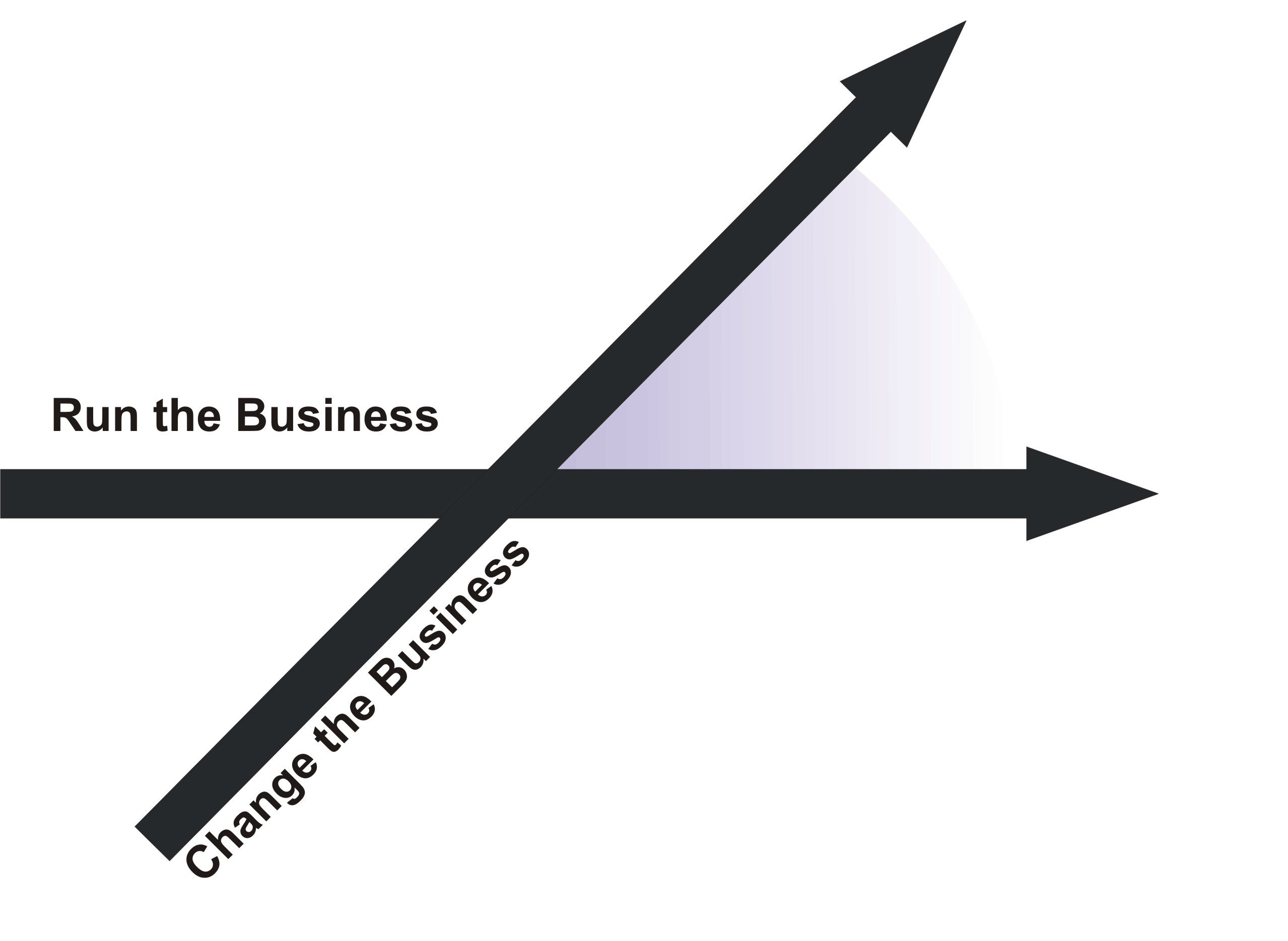
Keeping our analogy in mind, two kinds of “machinery” are needed for heart surgery: the artificial heart and the stay-alive machinery. When we implant PM, we use two kinds of machinery as well … the Process Management body of knowledge (the artificial heart) and a Dual-Track Management System (the stay-alive machinery). In the context of implanting PM, the Dual-Track Management System we refer to is (1) a means of running the business (staying-alive) while (2) changing the business (connecting the artificial heart). 

No change initiative (like implanting PM) occurs in a vacuum. By definition, the change initiative must go on while the organization is “staying alive,” doing its “day job” of producing products, serving customers, collecting monies, and so on … in order to make a profit for share/stakeholders.

The dual-track management system can be represented by the figure below, a reminder that businesses (and executives) must do two things at once … and they must do them both well if success in implanting PM is to be successful.

While there are a number of moving parts to a full-blown Dual Track Management System, a simple form can be easily visualized. Imagine a senior executive team that meets every Monday. Imagine that the morning session focuses only on Run-the-Business issues (e.g., progress toward financial targets, status on actions to fix customer upsets, manufacturing breakdowns, etc.). Further imagine that same executive team meeting each Monday  afternoon to focus exclusively on the progress the organization is making to transplant Process Management (e.g., who are the next managers to get PM training in Boston, what is the progress on the pilot PM project in Department X, where is the task force that is mapping core processes, how is HR coming in designing an incentive comp system that will reward individual management progress in using PM, etc.).

The regular practice of the two executive meetings each Monday becomes a rudimentary “management system” that provides focus and balance to both running and changing the business. This simple but powerful idea can be extremely valuable to organizations trying to transplant PM because it moves their thinking from an unconscious “implant PM OR run the business” to a conscious “implant PM AND run the business.”

Remember our first critical success factor of heroic leadership? It will take heroic leadership to keep this kind of dual-track management system in place … to keep from “canceling the afternoon meeting because we had a good change-the-business session two weeks ago” … or “we really need the time this Monday afternoon to get to the details of the current customer problem in the southern region,” and so on.

A Change Model

We have the patient on the table, we have the artificial heart standing by, we have rigged up the machinery needed to keep the patient alive during the operation, and now its time for the surgeon to complete the transplant. And nothing replaces the firm hand of a skilled surgeon guided by “a clinical pathway” of proven steps for implantation. We have a company that wants to implant PM: the body of PM knowledge is in hand, a run-change management system is in place … what’s needed now is a pathway for getting PM in play. While pathways (i.e., change management models) abound, we prefer a simple one as in the figure below.

This simple three phase model can be used as a pathway (or roadmap) for the implantation of PM (but keep in mind, the roadmap only covers “changing to PM,” not “running the day-to-day operations to meet business targets). The three phases sound simple enough: 

  • PHASE I: Build Awareness and Educate on Process Management and the Process Enterprise and the needed level of process maturity
  • PHASE II: Conduct initial trials of Process Management/Enterprise concepts and techniques in selected work processes
  • PHASE III: Integrate Process thinking into the day-to-day operations of the company

The table below shows the “next level of detail” in a transplantation roadmap. Note that there are a surprising number of detailed steps to be completed by the organization’s senior executives. They in essence become the surgeons who must get the transplant done while running the day-to-day business to targets.

Roadmap for Transition to Process Management

PHASE I:
Awareness and Education on the Process Enterprise

  1. Understand the Process Management movement as it applies to company
  2. Develop awareness of company needs for the next level of Process thinking and action
  3. Develop rationale for moving Process Management to the next level
  4. Leaders select and agree to roadmap for Transitioning to the Process Enterprise
  5. Develop Process Management champions
  6. Conduct informal Process Management assessment using a capability maturity approach
  7. Conduct next level Process Management awareness/education
  8. Develop business case for Phase II: Trial

PHASE II:
Initial Trial of Process Enterprise concepts and techniques

  1. Formally assess Process Management needs and current capability/maturity level
  2. Pinpoint, and assess strategic work processes and target the needed capability maturity level Click here for an example of a Capability Maturity Model of a Core Process
  3. Develop pilot projects around core work process to both "learn and do"
  4. Conduct just-in-time process enterprise training of pilot teams
  5. Make sure pilot results are put into action
  6. Launch other Process Management projects in other parts of organization…based on need
  7. Develop business case for Phase III: Implementation of targeted level

PHASE III:
Integration of Process thinking and Transition to the Process Enterprise

  1. Develop Implementation plans/timeline/measures/goals…including the target Process Management capability maturity level
  2. Incorporate Process Management measures/objectives into performance management system (goals and rewards)
  3. Formalize and integrate Process Management tools
  4. Identify and maintain an organizational environment supportive of targeted level of Process Management
  5. Modify work processes for Process Management effectiveness
  6. Take direct actions as needed to raise the Process Management capability maturity level to target
  7. Measure Process Management results

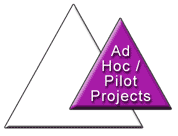
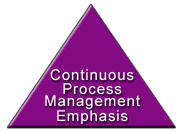
= Process Management Emphasis

Summary

The purpose of this brief white paper has been to clarify (we hope) Process Management and Change Management … and to show the critical role that CM plays in the implantation of PM.

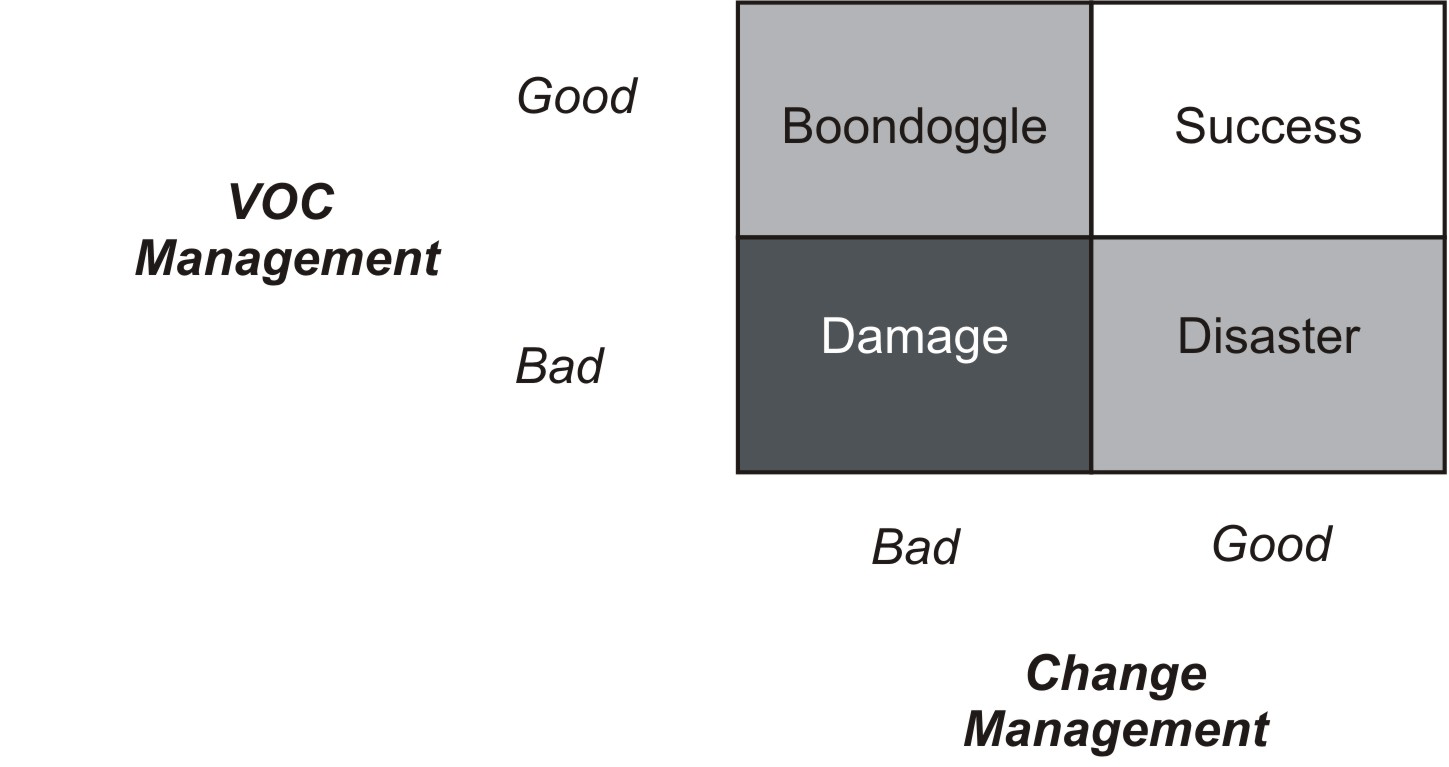
Lets take the heart analogy one final step and look at how PM and CM must work together to result in a healthy patient. Almost like football, four things can happen during implantation andthree of them are bad.

  1. Flawed PM content and invalid CM = organizational damage, wrong ideas about PM that are fortunately not implemented
  2. Flawed PM content and valid CM = organizational disaster, spreading ideas and practices that hurt, not help the organization to get better results
  3. Valid PM content and invalid CM = organizational boondoggle, a waste of time and money and a turn-off to the organization about PM value
  4. Valid PM content and valid CM = organizational results … that come from more effective and efficient business processes

The bottom line is that Process Management can enable powerful improvements in business results. Getting PM into play is the hard part. Transplantation of PM is a tedious and demanding undertaking that organizations can get done … if they have strong and heroic leadership, if they have a run-the-business/change-the-business perspective, and if they have a clear roadmap.

Like an artificial heart and the surgical equipment/procedures to implant it, PM and CM must be “joined at the hip” to enable success from Process Management.

If You Can't Measure It, You Can't Manage It

Change Metrics seem to be hot. What's the deal?

"If you can't measure it, you can't manage it." That mantra is as good today as when first spoken. But with regard to change, what do we measure? 

  • Change Impact - We make a change is our organization to have an impact. We can measure the impact of a change in two ways:
    1. Change in results - simply stated, we measure an output (Widgets/hour, cost per man hour, etc.) before a change ... we measure an output after we make a change ... and we compare the two. The difference shows the impact of the change we made.
    2. Change in means - simply stated, we can measure the impact of a change upstream of a result. We measure the flow at machine station four before a change and after the change and compare the two to get a read on the impact of change on one key step in producing a widget.
  • Change Progress - We initiate a change in an organization and we want to measure our progress in making the change. The three classic ways of measuring project work here. We can measure our progress on our change project by looking at:
    • Degree of completion
    • Schedule (Actual vs. planned) and
    • Cost (Actual vs. planned)

For example, at a moment in time in our project to increase the flow at machine station four we might be:

    • 60 % complete
    • 2 days ahead of schedule
    • $3,000 over our change budget
  • Bottom Line: Don't get the measures mixed up. Don't give a "change project manager" the metric of "widgets per hour" or her will be tempted to jump in and help make widgets ... rather than completing his change project (e.g., installing a production machine modification) ...on target, on time, and on budget.

http://bita.hdinc.com/en/art/81/

Thursday, December 3, 2009

Building a Foundation for Organizational Change

Making change happen is one of management’s perennial challenges. If you want a current example, just look at the CMO Council’s recent Marketing Outlook Report 2007. The top priority for CMOs is listed as ‘quantifying and measuring the value of marketing programmes and investments’. That sounds like it involves a whole lot of change: Change in what gets measured, change in how it gets measured and change in who does the measuring. And then there is all the change associated with using the measures to drive the business forward. The other nine priorities listed involve just as much if not even more change. I think you get the picture.

Change folklore suggests a number of foundation stones that must be put in place for real change to happen:

An Urgent Reason to Change
The first of these is an organisational crisis. One where doing nothing is not an option. A crisis forces the organisation to face reality and to prepare for the difficult journey to the new organisation. But a crisis by itself is just a recipe for organisational anarchy. The crisis must be managed in a way that it can be turned into an opportunity to grow stronger, not just an opportunity to survive in a weakened state.

Long-term Management Support
The second foundation stone is top-management support for the change. Top management support is necessary if middle-management is to take the change seriously. Otherwise middle management won’t make time for their direct reports to make the changes happen. And the change won’t become embedded in the organisation as daily business takes priority. But top management often starts change only to go on to start a newer change a short time afterwards. Top management must support the change over the 18-36 months required to embed the change into the new organisation as daily business.

Open & Honest Information
The third foundation stone is open and honest information about the change. Staff don’t like being told what to do. Least of all by ‘overpaid suits’ who don’t understand what life on the front-line is really like. They prefer to understand the nature of the change required and to decide themselves to engage. Change is an emotional process, not a cognitive one. Staff need to feel that the change is value-adding for them and that they have a real role to play in making it happen. But staff are very good at outing information where management says one thing, but does something else instead. Management must be open and honest with staff if the information is to be credible.

Experiential Training
The fourth foundation stone is training in the new world of work. Change is by its very nature new and frightening. Even positive change can quickly become negative if staff don’t know what it means for them personally. Staff need experiential training in the new way of work that the change will introduce. This will provide the foundation that staff need to start to make changed work into daily business. But training by itself only accounts for about 40% of the ‘training effect’. The other 60% comes mostly from providing staff with post-training support once back at the workplace.

Measures, Rewards & Punishments
The final foundation stone is measures, rewards and punishments that reinforce the change. We are all creatures of habit. This is rooted in the brain’s preference for routine activities that don’t consume much cognitive energy. That means the change must be supported by appropriate measures and rewards that reinforce the desired new behaviours. It may also mean punishing the wrong old behaviours. But they must be applied with care. No organisation wants alienated staff who were forced to change but whose heart and mind wasn’t really in it.

In a subsequent post I will set out how change actually occurs in organisations that have developed these foundations.

What do you think? Do you recognise all of these foundation stones in your own change programmes? Or is change something that never quite sticks in your organisation?

by Graham Hill

http://www.customerthink.com/blog/foundation_for_organizational_change